

Salmonfly Survival in Western Rivers and Why It Matters
At the recent Madison River Valley event hosted by the Madison River Foundation, vital research was shared by Dr. Lindsey K. Albertson on the status and future of the giant salmonfly (Pteronarcys californica), a keystone insect whose survival in western rivers is critical. Here’s what we learned about its ecology, challenges and why salmonfly survival in western rivers matters to all of us.
Why Salmonfly Survival in Western Rivers Is Critical
The giant salmonfly (Pteronarcys Californica) is one of the most important aquatic insects in western North America’s rivers. These large stoneflies spend years underwater before emerging in early summer, providing a massive, synchronized hatch that fuels food webs by feeding trout, birds, spiders and other wildlife. Beyond their ecological role, salmonflies support fishing economies and outdoor traditions cherished by many.
Recent studies show that salmonflies rely heavily on terrestrial leaf litter and woody debris washed into rivers, which make up about 68% of their diet. Algae like diatoms also contribute essential nutrients. This mix highlights the need for healthy riparian zones and intact aquatic habitats to sustain their populations.
How River Temperature and Landscape Affect Salmonfly Emergence
The timing of salmonfly hatches shifts based on river temperature and landscape features. With a broader temperature range and more human influence, the Madison River sees salmonflies emerging over nearly a month. This staggered hatch could benefit mobile predators who can track the resource along the river. Meanwhile, the cooler Gallatin River hosts a shorter, more synchronized emergence lasting about two weeks, likely supporting less mobile consumers.
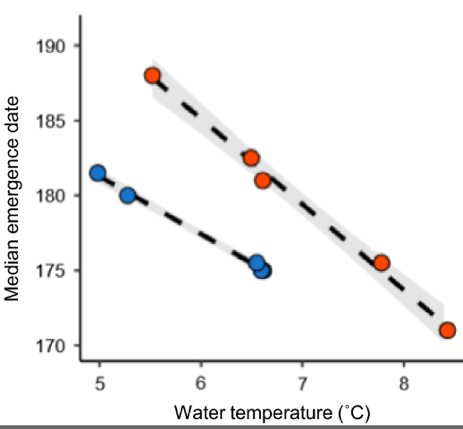
Emergence Timing vs. Mean Spring Water Temperature This graph shows how earlier emergence dates correlate with warmer spring water temperatures across sites on the Madison and Gallatin Rivers. This illustrates how temperature affects hatch timing and the staggered vs. synchronized emergence pattern.
Read the paper here.
Unfortunately, warming waters are shrinking salmonfly numbers and body sizes. The Madison River has already lost half of its suitable salmonfly habitat, with models predicting further declines by 2100. Smaller salmonflies mean fewer eggs and reduced food for predators, threatening the entire ecosystem balance.
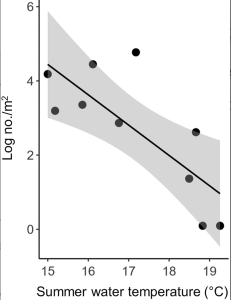
Salmonfly Density vs. Summer Water Temperature
This graph clearly shows how salmonfly larval density (Log no./m2 on the graph) drops at sites with warmer summer water temperature. It visually reinforces the link between anticipated warming waters and population decline.
Conservation Efforts for Salmonfly Survival
Protecting riparian vegetation, restoring cooler river temperatures and monitoring populations will be essential to conserving salmonflies. Engaging anglers and local communities in citizen science can help track changes and support conservation efforts.
The giant salmonfly is more than an insect; it symbolizes healthy, vibrant rivers and the connections between water, land and life. Saving the salmonfly means preserving these wild places and the outdoor heritage they sustain.